
Yosemite’s Other Domes
Beyond Half Dome, less famous granite treasures hiding in plain sight.

Yosemite Valley in peak season can test even a hiker’s love of wilderness.
Traffic crawls around the valley loop. Parking lots overflow before breakfast. Trails to Vernal Fall and Upper Yosemite Falls resemble hiker conveyor belts
I was one of many who applauded the National Park Service when it implemented a reservation system during the pandemic years. Millions still visited Yosemite, and visitation continued climbing, but at least the park regained a measure of breathing room. A measure of quiet.
This year, with the reservation system abandoned under pressure from the Trump administration, the crowds feel bigger than ever. And yet…
The moment I catch sight of Half Dome rising above the Valley, all irritation disappears. That impossible granite face still stops me cold, just as it did the first time I saw it more than half a century ago.
Which may explain Yosemite’s dilemma. The park is too beautiful for its own good.
My solution isn’t to avoid Yosemite. It’s to walk sideways through it.
Because Yosemite is a land of domes, not just the Dome.
Half Dome gets all the glory. Fair enough—it’s one of the most recognizable hunks of granite on the planet. But Yosemite’s granite world extends far beyond its celebrity summit.
Sentinel Dome, North Dome, Lembert Dome—these are the quieter siblings in Yosemite’s granite family. Walk up them, not up to them, and you’re rewarded with sweeping, 360-degree views that rival anything in the park. From North Dome, you even get something Half Dome can’t offer: a perfect, face-to-face view of Half Dome itself. Consider it a little granite irony.
For the geology-minded, here’s the short version: deep underground, molten rock cooled slowly into massive granite. Then came uplift, glaciers, and a process called exfoliation—layers of rock peeling away like an onion left out in the Sierra sun. What’s left are these smooth, rounded domes, polished and shaped over millennia.
Best of all, the trails to these domes tend to see fewer hikers. They sit just far enough from Yosemite Valley’s busy corridor to feel like discoveries.
Same park.
Different perspective.
Sentinel Dome
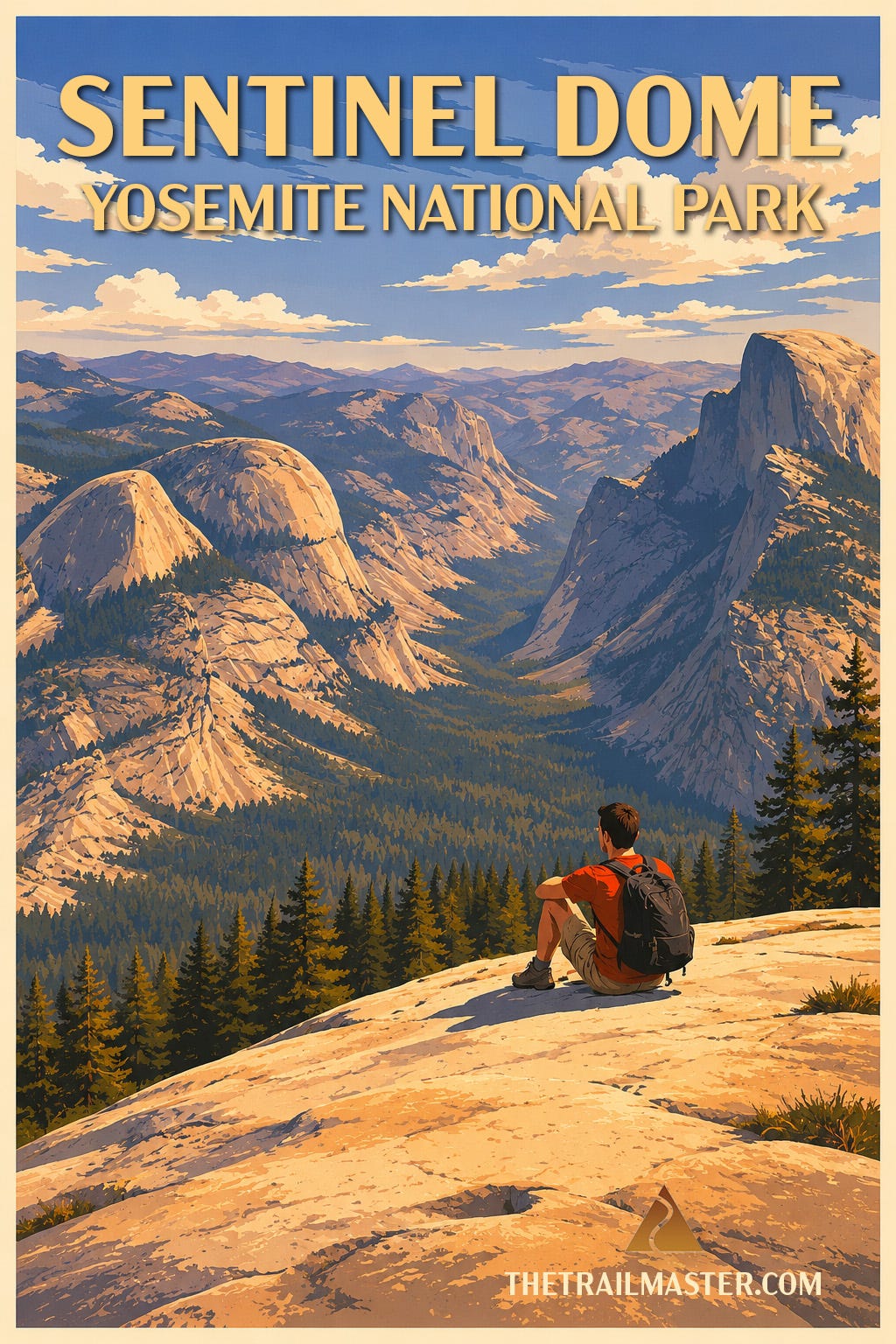
Rarely does so little hiking buy such a sweeping view. From the rounded top of 8,122-foot Sentinel Dome, Yosemite’s icons are arrayed like a diorama: Half Dome to the east, El Capitan to the north, Yosemite Falls plunging from the rim, and the Clark Range rising in the distance.
For years, the most famous tree in Yosemite also stood here — the twisted Jeffrey pine immortalized by Ansel Adams. It finally toppled in 2003, but the dome remains a place where photography, poetry, and geology all compete for attention.
Compared to Glacier Point, the dome feels more personal. You earned your panorama, step by step on a 2.2 miles round trip hike, rather than driving up. And the crowds, though steady, are never as overwhelming.
North Dome
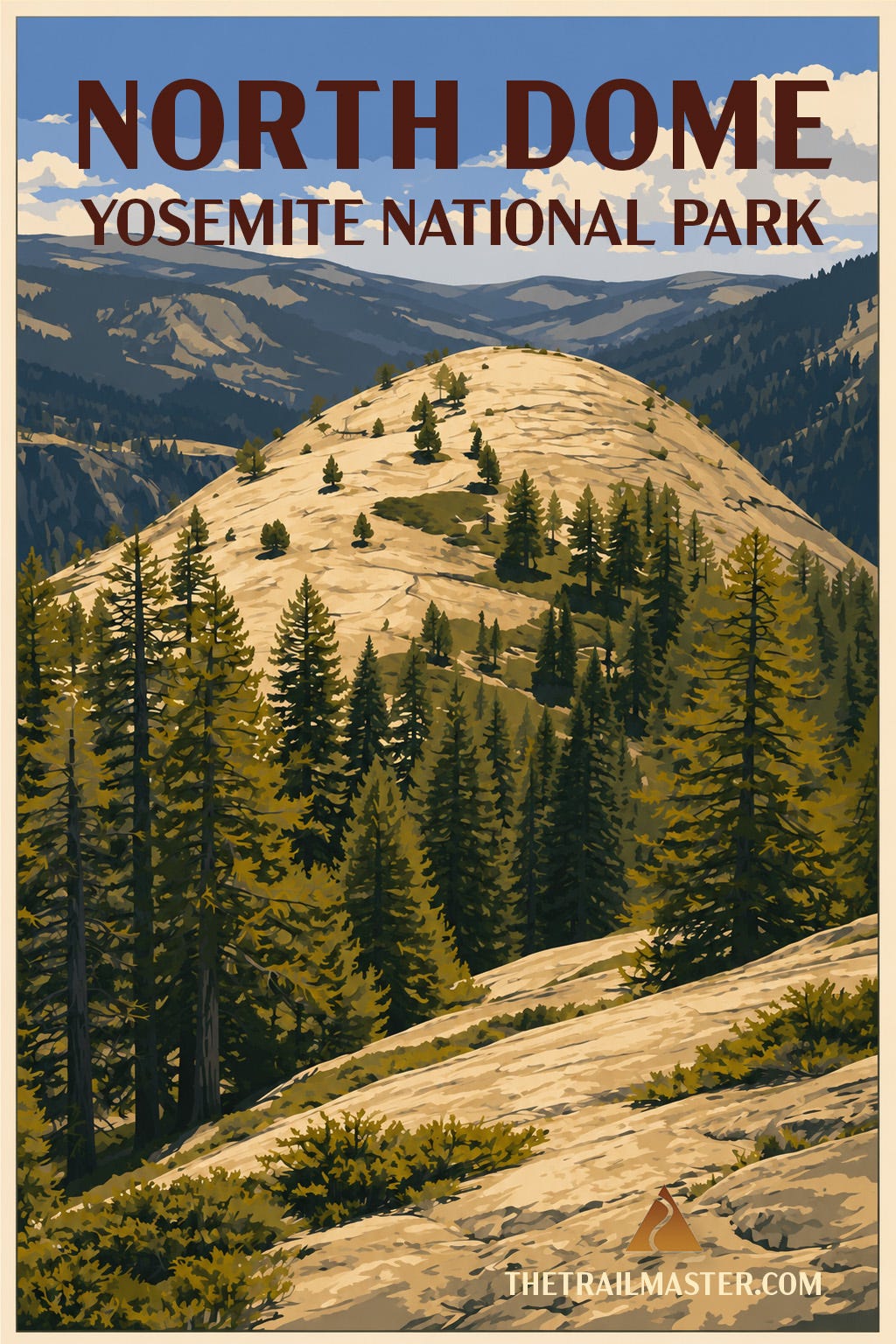
From the floor of Yosemite Valley, Half Dome is untouchable—always above, always iconic. From North Dome, you finally stare it in the face. No glass, no guardrails, no crowds—just you and the granite giant, eyeball to eyeball across Tenaya Canyon. Few spots in the park offer this kind of intimacy with the most famous hunk of rock in America. Half Dome fans say the Yosemite icon offers superior views, but North Dome devotees point out that North Dome offers something Half Dome can’t provide—a view of Half Dome.
From a Yosemite floor perspective, 7,542-foot North Dome dominates the north wall of Tenaya Canyon opposite Half Dome. It appears impossible to ascend but, surprisingly, the rounded mass of granite can be traveled and topped by a moderately graded pathway.
The 9-mile round trip hike (with a modest 600-foot elevation gain) to North Dome begins at Porcupine Flat, home to scores of the namesake creature, whose favorite food source is the inner bark of conifers—lodgepole pines in particular. A generous selection of other Yosemite trees may be glimpsed en route: Western white pine, Jeffrey pine, red fir, and huckleberry oak. Several life zones overlap at this elevation (about 8,000 feet), creating this intriguing collection.
Extra added attraction for the hike is Indian Rock, an unusual stone arch perched atop Indian Ridge. The delicate, 20-foot arch, scarcely one foot thick at its thickest part, is not Yosemite’s only arch (another is below the surface of the Tuolumne River) but it is the only one accessible to hikers.
The hike itself is a sampler of Yosemite high country: a bit of forest shade, a broad ridge with wildflowers in spring, some classic Sierra granite slabs. North Dome waits at the end like a balcony seat in the world’s grandest theater. Walk out onto its smooth summit and the Valley rearranges itself: Clouds Rest stretches long and lean above, Glacier Point juts dramatically opposite, and far below, the Merced bends and glitters.
This is a hike that makes you work a little—long enough and high enough to matter—but pays off with a view that stays with you, a conversation across a valley you’ll never forget.
Lembert Dome
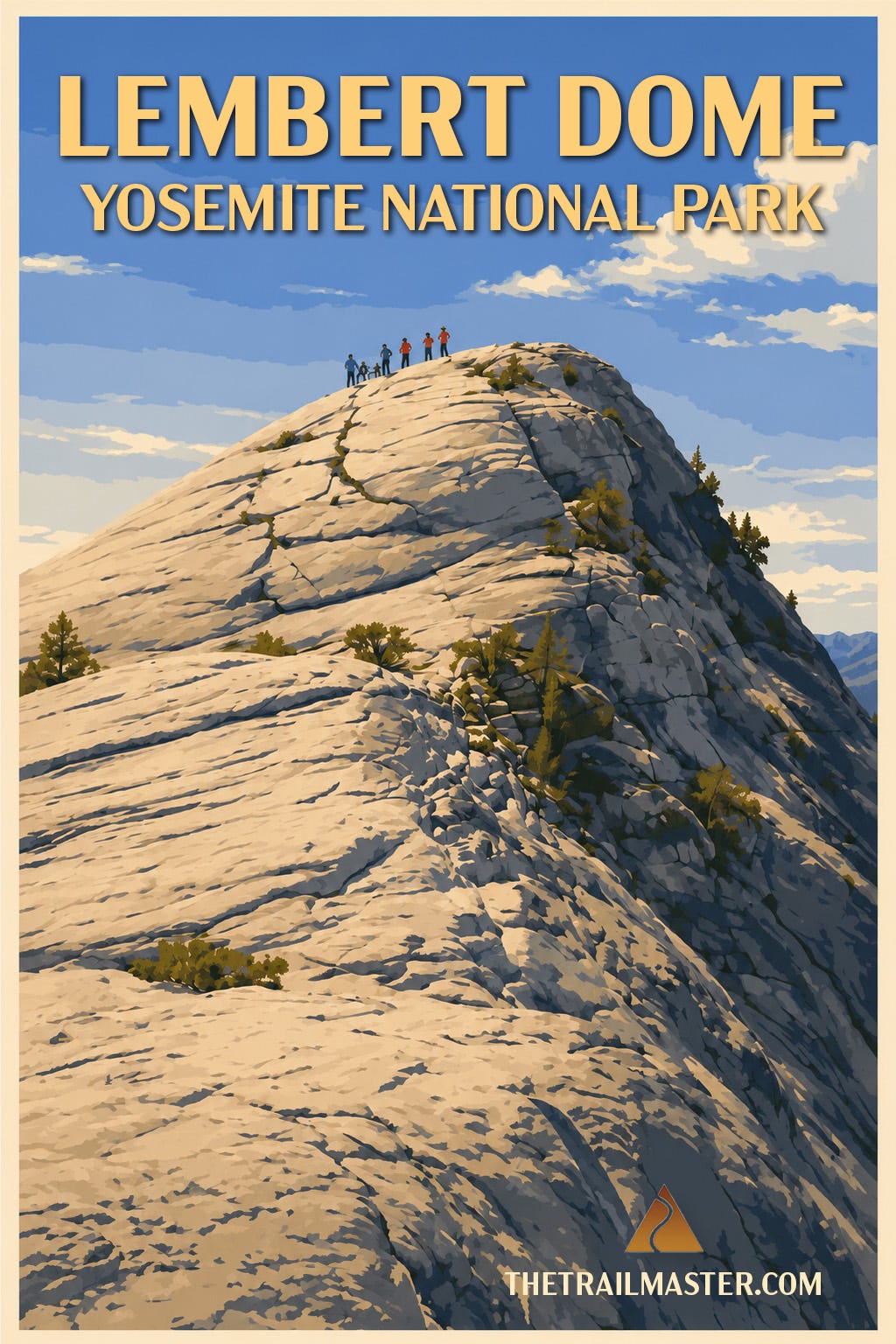
Some domes require a long preamble. Lembert gets right to the point—a clean granite whale shouldering up from Tuolumne Meadows, begging you to climb its back and see what the high country is really about. In the time it takes to sip a cup of coffee, you can be on top staring at a 360-degree map come to life: Cathedral Range marching south, the meadows braided with river light, Mt. Dana’s dark shoulders to the east.
The 9,450-foot dome looks impossible to scale when regarding it from the trailhead, but fear not. For the time-short (but not stamina-short) traveler, able to do only one hike (3.5 miles round trip with 900-foot elevation gain) in the Tuolumne Meadows area, Lembert Dome is the one to do. From atop the dome, you’ll have Tuolumne Meadows and Yosemite Valley at your feet, and view a parade of peaks from Cathedral Peak all the way to Mt. Dana at Tioga Pass.
Geologists say Lembert Dome is not a true dome (such as Sentinel Dome) but a rouche moutoonee; the French phrase “rock sheep” describes a glacier-carved formation recognized by its sheer front and sloping back. The rouche moutoonee was named for shepherd/naturalist Jean Baptiste Lembert, who began work in Tuolumne Meadows in 1885. An unsolved mystery to this day is who shot him dead in his cabin—and why—in 1896.
Kids love the hike to Lembert Dome; so do geologists and anyone with a camera. The companion piece, Dog Lake, sits in a forested bowl and invites a cool detour either before or after the summit.
Half Dome deserves its fame. But Yosemite’s quieter domes offer something increasingly rare in the modern national park experience: space to sit with the landscape rather than simply pass through it.
Ascend one of them early in the morning, before the Valley traffic builds and the crowds gather below, and Yosemite begins to feel immense again.
Footnotes
More details about hiking the domes at thetrailmaster.com:
To learn more about tectonic forces, glacial activity, and how domes got to be domes, check out Yosemite National Park’s Geology Tour.
Hike On,
John McKinney
The Trailmaster
“Every trail tells a story.”
From the Trailmaster Library
More about Yosemite National Park:
Trailmaster T-Shirts & Hats


TheTrailmaster.com
YouTube | Instagram | Store
If this newsletter was forwarded to you, subscribe here.